Tuesday, July 24, 2012

Literary Kale


As you may have guessed, I'm always on the lookout for good literary vegetable passages. Thoreau is still my favorite wielder of worded vegetables, especially his passages on pumpkins and beans. So I was instantly delighted at reading the first line of Heidi Julavits' review of the racy werewolf novel Talulla Rising in last Sunday's New York Times Book Review :

If literature is lacinato kale, genre is gelato.

An extremely erudite vegetable reference, lacinato kale being the blackish green brassica also known as dinosaur kale. Was she implying that those of us who know what lacinato kale is and regularly enjoy it are most likely to also be literary snobs? That we enjoy what's more challenging to appreciate, what the common folks who are chomping on iceberg lettuce do not take the time to notice? The first part may be in there, but she jumped straight from vegetables to dessert, implying the cultural divide is even more extreme. But perhaps reading novels these days is already highbrow, so that liking mysteries or thrillers is more like eating gelato (still the mark of discerning taste) rather than soft serve or Breyer's.

But tastes are contradictory and likely to cross all sorts of so-called cultural boundaries. Once, my former roommate, who used to research food trends, took a picture of my breakfast because she wanted to capture the incongruity of my organic, farmers' market strawberries sliced over a bowl of Lucky Charms that were soaking up local, organic whole milk from Straus Family Creamery.

So I appreciated the way Julavits, a novelist and an editor of The Believer Magazine, took her initial "kale : literature as genre : gelato" metaphor and spun it into a miniature reflection on the mash-up frenzy driving urban food trends as a way to understand similar literary splicings. She continues:

Despite regular critical attempts to reconstruct this outdated food pyramid, the base holds strong. Fortunately, thanks to a surge in literary molelucar gastronomy, readers can enjoy an ever wider array of broccoli rabe (or brussels sprout, or Swiss chard) ice cream. When cooked by mad word scientists like Glen Duncan--whose new horror novel, "Talulla Rising," is a sequel to "The Last Werewolf"--this harmonic hybrid delivers sweet (plot), salty (character), sour (emotional pathos), bitter (psychological probity) and umami (stylistic and linguistic panache).

I think the inclusion of "umami," or the fifth flavor, shows this is a woman as serious about food as she is about books. Just when you think you've gotten to the dregs of the food metaphor, it keeps on going, perhaps inspired by the horror genre she's reviewing (ha! not dead yet! a relentless attack!):

If books were required to list the nutritional value of their contents, Duncan's sumptuously gluttonous werewolf saga would rank as high in pure cane sugar as it does in omega-3s. 
Note how she uses cane sugar and not corn syrup. Like the careful choice of gelato, she's saying Tallulah Rising is a little naughtier than kale but still not the trashiest thing you can ingest. The book looks really fun, by the way, feminist in its narrative of female werewolf empowerment but with a dose of True Blood-style sexytimes. I will be totally honest and say it was actually this pull-quote that got me to stop turning the pages and read this review:

Can a woman who kills and consumes innocent people and craves near-constant sex be a fit parent?

Ahem. Lettuce turn back to vegetables... Ms. Julavits' opening paragraph clearly planted a tiny green seed in my imagination, as I kept envisioning a book made of kale leaves, one that I could read and eat at the same time. It grew and grew in my mind, until I sat down after dinner and painted it (above). The lacinato, or dino, kale is on top, alternating with Red Russian kale, which I love for its delicate colors, texture, and flavor.

Saturday, July 21, 2012

Time For Twig Tea


Just over here sipping on some twig tea in the nebulous region between Oakland and Berkeley, part concrete jungle and 2am Jack in the Box drive-thru binges, part sunshine garden idyll and self-righteously organic paradise. The air is scented with tiny jasmine blooms and the heady spices of Cafe Colucci, one of the Ethiopian restaurants that pepper almost every block in my new area.


I don't think I can make a convincing case for twigs as vegetables, since we can't really eat them, just drink hot water they've been soaked in. Still, it does feel strange and notable to drink infused twig water. You can get kikucha (its Japanese name) in sachets, but I like to get the actual roasted twigs. Feels a bit more witchy that way... I think I got these from Rainbow Grocery over a year ago--I found them in a box I unpacked with all my old teas and spices in it (still good, dammit, though the spices probably have their best days behind them).

Kikucha is not as weird as you might think at first, however, when you realize that the twigs are not just any twigs but come from the tea plant, whose black/green/white-leaf water we're more used to drinking. Kikucha has a little caffeine, which is why I'm drinking it as I wean myself off coffee for a week or so (just so I can restart the addiction with fresh vigor). I got really into twig tea when I tried adhering to a macrobiotic diet for a week-and-a-half and nearly lost my mind--I felt so much healthier but proportionately crazier for all the cravings left unfulfilled. But twig tea was a good friend in that time of need and no coffee.

I find its amber hue and mellow, smokey flavor very soothing even as it cuts through my drowsiness. It's not as bitter or jarring as some green teas can be and also not as strong as black tea. I often drink it after dinner when I need to get some writing done but still want to feel a little dreamy and be sure I can fall asleep when crawling into bed. The roasted brown rice genmaicha is also another favorite tea with a deep yet delicate flavor, but its portion of green tea makes it too caffeinated for me to drink at night.

You can read more about twig tea here and here.

Saturday, June 30, 2012

Meanwhile, back at the San Francisco Ferry Building...

Being born and raised in a place like San Francisco should normally make a person avoid tourist tornado zones and the risk of being mistaken for a tourist at all costs (Fisherman's Wharf doesn't even register on the native's mental map of the city), but after having spent a year away from my "cool, grey city of love," I was inspired to break one of my cardinal rules: never set foot in the Saturday Ferry Plaza farmers' market after noon. Before 10am is ideal, after 11am is getting a little hectic, and after 12pm is total insanity, destructive tourist gremlins all over the place and everyone headed for a collective meltdown.

But the siren song of this produce paradise was too much to bear, and since I wasn't actually shopping for vegetables because I don't have my own kitchen yet, I decided that I might as well be a tourist and walk around staring at California's most beautiful vegetables and be that annoying person who just snaps creepy photos and doesn't buy anything except a breakfast egg plate and Blue Bottle coffee.

While loitering and enjoying said egg plate and coffee, I took notice of the carnival of harmless tourist profiteers that I normally ignore in my rush to be the first to fondle the doughnut peaches and heirloom greens. Superman was sweating buckets under his muscle foam while boinging merrily around on pogo boots, collecting tips for photos ("It's for health insurance!," he told onlookers with a winning smile. I assume it's to uphold his individual mandate and give the necessary support to the healthcare reform package than out of any real need for health coverage. Man of steel and all...). Magicians, clowns, and fresh-faced folksy singers in cowboy outfits rounded out the sideshow, providing much-needed distraction from smartphone data feeds.

Despite being comforted by the familiar sight of northern California blooms and plaid shirts, I was dismayed to see a sign that the farmers' market has gotten overly crowded and militantly regulated:


But as I strolled past my favorite vendors, all of whom can be found on the CUESA website, I moved on to more satisfying sights, like the multi-colored heirloom tomatoes at Balakian Farms that made me want to dive in and shout, "Treasure bath!!!"


And the tranquilly delicious scents of lavender and strawberries at Eatwell Farm:


Floating dreamily past the brown turkey figs at Knoll Farms, which are fat, pale green, and dusty purple, past the sweet-smelling stone fruit of Frog Hollow and Blossom Bluff, I wafted into my personal favorite weird greens triangle of Heirloom Organic Gardens, Star Route, and Marin Roots farms.

Heirloom Organics had its usual dazzling rows of salad and braising greens, plus an explosively cute wicker-and-gingham array of pale purple borage and what look like marigolds, alongside delicately tendriled pale carrots (or could they be baby parsnips? hard to say in retrospect).


Star Route's bounty of rainbow chard and assorted greens (ancho cress, tatsoi, red mustard, and dandelion greens) was holding up well under the swelter of unseasonably hot weather (San Francisco is supposed to be gloomy and foggy in June, a mean joke played on tourists who end up having to buy cheap fleeces embroidered with "SF" in Chinatown).


I flirted with their stinging nettles for awhile but decided to make that nettle soup, pizza, or pesto into a future ambition.


Gandhi was looking well-accompanied by a conspiracy of beards as I sauntered from Star Route across the way to Marin Roots to compare the price of designer weeds.


In a twenty-first-century weeds-to-gourmet story, the slightly chewy succulent with teardrop leaves known as purslane has risen to veggie stardom, partly on the crest of its omega-3 riches. It is lovingly cultivated by both Star Route (for $6/lb) and Marin Roots ($8/lb). Perhaps the latter's purslane was a bit larger and more comely, hence the premium. I also found a heretofore unknown weird vegetable at Marin Roots known as chocolate mint.


In an interesting twist of the human mind/palate partnership, chocolate mint does not taste like chocolate but is reminiscent of chocolates that feature this strong mint flavor, like Andes or Peppermint Patties. My slightly lazy clicking through the Internet has rendered insufficient information to say when this "chocolate mint" was thus named, but it's an interesting case of an herb taking on the name of a candy that previously took its name in part from a close relative of that same herb. (In the beginning there was mint, then there were chocolate after dinner mints and there was mint chocolate as an ice cream flavor and flavor of chocolate, and finally there was the chocolate mint for $2/bunch for sale with the spearmint at the farmers' market.)

Marin Roots also had some very alluring radishes waiting to be ravished:


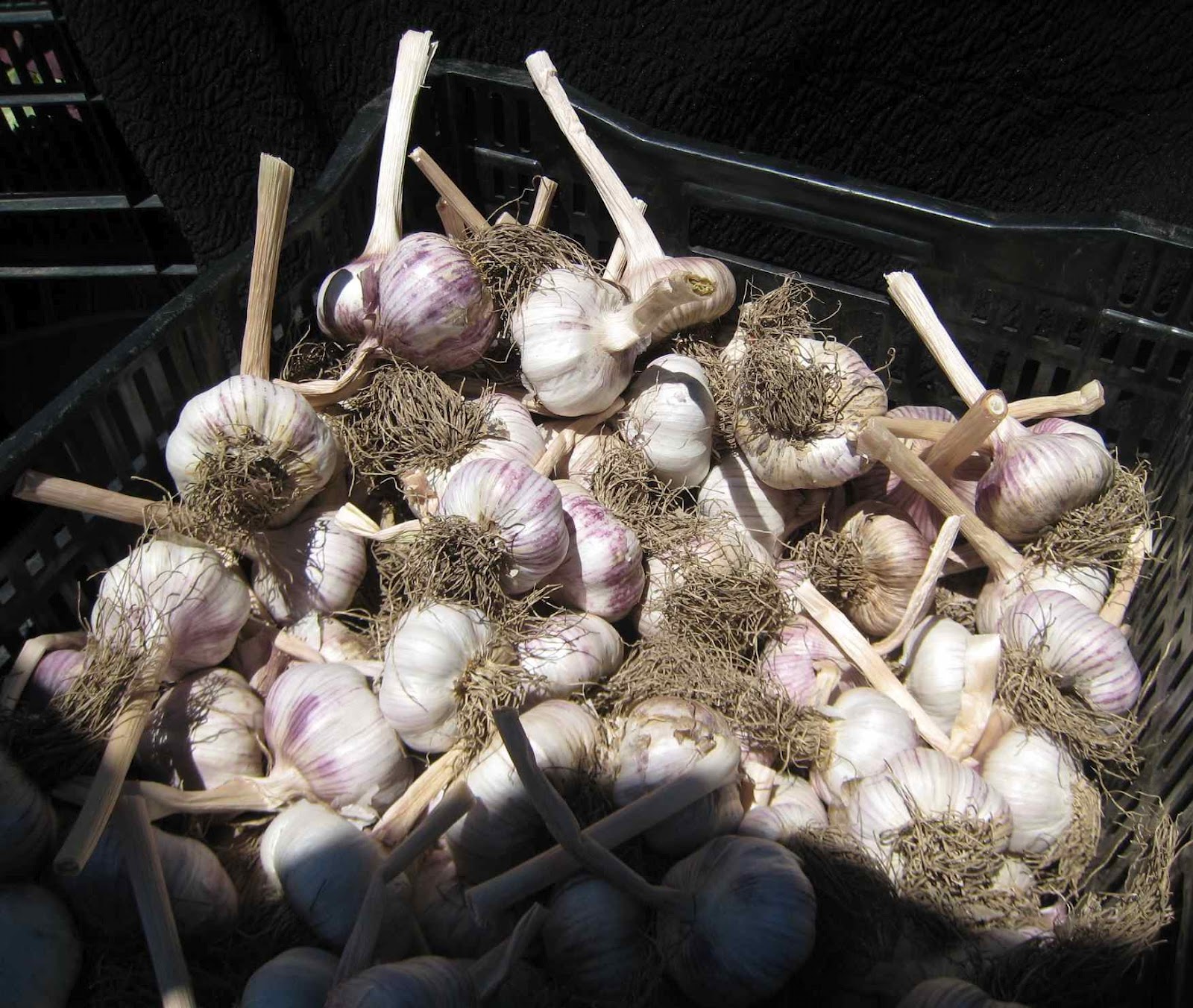
After the endorphin-inducing triple-whammy of weird greens, I usually veer right (or south) and poke my head in among the beans, yarn, and dried hot peppers at Tierra Vegetables, which usually has an odd yet rustically intriguing assortment of vegetables. Today their onions and garlic were especially luscious. Maybe I've been away for too long or these were the only things not wilting in the sun, but for some reason onions and garlic seemed to be the most gorgeous and mouth-watering vegetables at the market.


See how pretty these red burger onions look in the sun?

And the chiaroscuro effect of the garlic bin!


Around the corner and rounding out my Ferry Building vegetable nirvana is Dirty Girl Produce, whose cherry-red early girl dry farmed tomatoes I die for in late August/September. Today they had the world's most adorable fist-sized romanesco, of course sitting next to yet more pretty onions:


Spycam shot of the Dirty Girl stand through Twin Girls' flowers (or did they belong to Four Sisters? Sometimes I get all the farm girls mixed up):


And next door to Dirty Girl was a farm I'd never seen before, Hunter Orchards, which had its own formidable garlic pyramid and some bright red jackpot cherries.


Not sick of onions or garlic yet? Here are even more from Heirloom (left) and Eatwell (right).


It's beautiful and overwhelming to be back in the Bay Area, starting life back up here and returning to my most favorite vegetables in the world. I'm about to move to the East Bay, though, for logistical and rental price reasons (goodbye expensive Mission District—I bequeath you to the Facebook + Google + assorted tech startup army and the rent control holdouts!), so expect some posts on Berkeley and Oakland farmers' markets in the near-near future.


Wednesday, May 16, 2012

Artichoke Intensi-TEA


Last month, my veggie-loving friend in Rio, Celery Kabbage, brought me a sweet present of artichoke tea. I'd never had it before—neither had she—and we brewed a pot after dinner. As the artichoke leaves steeped, we imagined the gentle, pale green tones of artichoke distilled into pleasant tea form, perhaps a little on the weak side. I thought of the way that eating artichoke leaves a slightly sweet aftertaste to the water you drink with your meal. I took the improvised kettle off the stove-top and served us both. We blew delicately, then sipped...
 

... and nearly spit the evil witch's brew across the room. If Ms. Kabbage hadn't joined in the tasting, I might have thought she'd been trying to poison me. It reminded me of the bitter herbal infusion my dad's acupuncturist made him drink for his allergies or the taste of the betelnut I chewed to be social while sitting on the ground with old ladies in Vietnam. And yet somehow more foul than either, partly because I'd expected a more literally "artichokey" taste. [Please insert pun on arti-CHOKE here.]

Anyway, thistle is all to warn you: please to only drink the artichoke/alcachofra tea in case of interest in reputed medicinal qualities, such as stomach and liver relief and weight loss. I don't know how it's all supposed to work, but I can think of a whole bunch of smart alec responses about how this truly awful tasting tea can kill your appetite and make you forget your stomachache because of the bitter bitter flavor in your mouth that is disfiguring your facial expression. Or maybe I should focus on opening up my mind and all my vegetable chakras and try it again, only this time using 1 leaf per cup of boiling water...

Tuesday, May 15, 2012

Weird Vegetable Iron Chefs at the NY Food Book Fair

Wild tamarack, basswood leaves, garlic mustard, fiddlehead ferns,
and knotweed over Spanish mackerel. Source: NPR

While some of us gaze dreamily out at the rainy rainforest in Rio de Janeiro, others are busting their chops organizing book fairs and slapping together improvised gourmet dinners in the throbbing capital of, well, capital and haute cuisine: New York City. Congratulations to Elizabeth Thacker Jones for pulling off the first-ever New York Food Book Fair in high style at the Wythe Hotel in Brooklyn (and proving that grad students can actually meet deadlines and be "real people" too) and to WV friend Leafy Heirloom (aka Leif Hedendal) for whipping up what looks like a very tasty, very veggie-inspired meal to accompany the event—and for getting his leafy mug featured on the NY Times food blog.

The Garden Gather dinner was held in honor of John Cage, genius of music and mushrooms, and co-founder of the New York Mycological Society, but the wild mushrooms that were supposed to be the centerpiece of the meal suddenly got shy of all the attention, so Leif and his co-chef Mark Andrew Gravel improvised with a whole bunch of New England-foraged greens that they'd never heard of before. The NY Times blog and NPR both covered the event, making it sound like an unexpected Iron Chef competition starring weird vegetables. The featured weird vegetables included twelve pounds of dried heirloom red cowpeas that Gravel packed in his carry-on bag from South Carolina, ramps, basswood leaves, tamarack shoots, lily shoots, knotweed (eh?), ground ivy, toothwort root (what?), sweetflag (what??), and fiddlehead ferns (relatively normal in this esoteric company). The chefs used a combination of the Internet and their instincts about texture and flavor to make the knowns and the unknowns all work together. Another top-chef secret shared by Leif went beyond the forest and into the sea. He made up for the unexpected dearth of mushrooms "by getting a lot of seafood—that's my idea of improving something, is throwing a lot of seafood at it." Oysters, blue crab, and mackerel. Sounds fishy, but we trust his Leafy heart still blooms green.

Toothwort root and knotweed, though I'm not going to pretend I know
which is which,  (I'm assuming that NPR's caption puts them in l-r order...)

The NYT write-up gives a fuller view of the context of the book fair and the meal, while NPR's piece focuses more on foraged greens and the potential incongruity of a swanky $150 per person meal being concocted from what might be considered as weeds: "In a different era or a less rarefied location, such a plate might suggest poverty — someone forced to scrounge for scraps (whey) and weeds (cattails) because they couldn't afford anything else."

This redefinition of obscure and foraged vegetables as a product of specialized knowledge (both in the gathering and preparation) that carries with it a certain aura of exclusivity and gourmet cachet is a tendency that has marked the culinary Zeitgeist of the past few years. Of course exclusivity and gourmet cachet are nothing new in the world of fine dining, but the attention dining-obsessed eaters are suddenly granting to the endless variety of vegetables that chefs are seducing them into accepting (with lots of butter, high quality olive oil, and creative combinations) has been an interesting and complicated phenomenon to witness—though always pleasing to experience when I'm lucky enough to taste one of these expertly prepared meals.

But it sounds as though this Brooklyn-based weird vegetable sermon was served to the choir, since one of the guests was already rapturing to the NYT about the greens he spotted on the way to the dinner: "It's really hard not to pick the lamb's quarters and the shepherd's brush that is growing within a block of here."

We at Weird Vegetables (the royal "we" of Kale Daikon and sometimes Eggplant Kohlrabi) look forward to a Bay Area incarnation of the Food Book Fair with much watering of the mouths and minds.

Monday, April 30, 2012

Vegetable Dressing

"Tutti Fruity" from the New York Times


Look at the New York Times getting all heady with edible fashion and food puns in their spread "Salad Days" from a couple weeks ago... I don't know whether I want to graze from this dress or just throw it all in the compost. The Arcimboldo inspiration is pretty creative, but some of these spreads made me feel abject about the model who got duped into these scenarios (like the one where they stuffed a fish in her mopey mouth, as though reminding her that models are there to look pouty but never speak). I much prefer self-authored perversities, like Suzan Pitt's asparagus animation (see previous post!).

Psychedelic Asparagus


Please watch this amazingly INSANE animated journey by artist Suzan Pitt while you are eating asparagus and sitting on the TOILET. It is going to blow your mind. I really like the saturated colors and the rounded, chubby shapes. Makes me think of Brazilian Tropicália. Thanks to the talented Internet huntress Amaranth Gadberry for unearthing this wonder from the year 1978.

UPDATE 5/15: Uh oh, sorry. Looks like the link pulled one of those "flower that blooms for a night and then fades away" disappearing acts on us. No more crazy asparagus video. Maybe it'll crop up in a different Internet weedbed somewhere. Send any leads on where to find this movie to weirdvegetables AT gmail.com