Tuesday, February 14, 2012

Veggie Plops.


Veggie plops. That's what I'm calling these. It looks like someone just dropped these cabbages and squash from a high place and they landed into the shape of veggie-hued Hershey kisses. Spotted outside of a dusty old market on an island southeast of Rio de Janeiro called Ilha Grande, home to just four automobiles (firetruck, police car, school bus, and one other car) and a whole pack of happy dogs that have people who love them and feed them but that roam the island freely like cats due to aforementioned lack of cars. Here is the full shot of the market:


I like that these veggies masquerading as giant dim sum dumplings get such primacy of place, the star attraction alongside the brooms meant to lure in potential customers. That pink bike is pretty sweet too.

More soon! Carnaval is coming to Rio (oh, the humanity! drunken crowds marching all over my poor beer-soaked, sandy toes!!) and I have a sore throat. Maybe that will keep me home and posting more about weird vegetables.

Friday, January 27, 2012

Routes. Routes. Routes. Routes. Roots. Roots. Roots.


Ahoy!! Here I am, just washed ashore in Rio de Janeiro, where I crawled and then climbed up into the green profusion of its rainforest hills to settle into my hermit hole for awhile. I was off for a couple months of vagabondage and checking in with the proper dissertation authorities and libraries back in California. I had little down time to post, though I've taken lots of pictures of vegetable friends I've met along the way (the WV pantry mountain continues to grow ever higher with yet-to-be consumed future posts). So after traveling over routes --> routes --> routes --> routes of hemispheric and ocean criss-crossings, I'm hoping to sprout some fast and glorious roots --> roots --> roots in my recently reinstated tropical environment in as little time as it took this sweet little potato to spread its slender fuschia root-arms in a great big hula welcome to the world. More roots = more vegetables = more WV posts!

p.s. "Routes. Routes. Routes. Routes. Routes. Routes. Routes." is a phrase that runs through my head every now and then. It's from the English translation of Brazilian poet Oswald de Andrade's amazing and confounding "Cannibalist Manifesto," (Manifesto Antropófago), which you can read about here. And here is a pdf of Leslie Bary's translation, which is much better than other versions with cringe-worthy errors that are floating around the web and that shall remain uncited here.

Saturday, December 24, 2011

Solid Borscht (or Beet & Carrot Latkes)

Hello from Jerusalem! I've gone to the Holy Land for the holidays to be with some good friends who live here... and am learning a great deal from the intensity of life within a deeply interwoven knot of three major religions and their innumerable sects. A dizzying experience: mingling in with Greek Orthodox, Coptic Christian, Franciscan, and Ethiopian priests, pilgrims singing and kissing relics, and tourists looking bewildered at the Church of the Holy Sepulchre, feeling the divine spirit with Jewish worshipers at the Western Wall and feeling out-of-step for not backing away from it, drinking sweet mint tea offered by Muslim vendors in the narrow, curving passageways of the old city and studying the façades of mosques I cannot enter. The vegetable backlog has grown past the top of my head, but here is a special morsel to tide you over through the holidays.

These are beet & carrot latkes, which are perhaps not so very strange, but I had only ever had the Hanukkah treat in its more traditional potato form. And thus, these make it into the pantheon of Weird Vegetables by virtue of their unorthodox chutzpah and extra-ordinary deliciousness. Made with love by my friend Zoe's mom Paula and eaten with generous dollops of applesauce and plain yogurt, these latkes caused one happy eater to exclaim, "Wow, together with the yogurt, it's like solid borscht!" Which, in our vegetable-loving context, is akin to saying "It's like solid gold!", but better because you cannot eat solid gold. The recipe is from The Joy of Cooking.

May you eat well and light some candles of love and merriment over these next few days.


Tuesday, November 29, 2011

Volunteer Corn


Our weird vegetable field has lain fallow for a spell as your virtual farmer-forager takes a pause from her Brazilian sojourn to touch down in Occupied U.S. territory and witness what's been sprouting in the late North American autumn. Despite this writer's preoccupation with the bruised hands and ribs of her colleagues at the University of California, Berkeley and the violent peppering of peaceful bodies across this state and country, as well as her fulfillment of non-vegetable-related tasks with non-negotiable deadlines, others have been pitching in to help keep up production. And so, as in the natural world, what seems to be abandoned by human activity, is in fact not forgotten by all. Seeds germinate in the minds of others, photos are snapped and forwarded on behalf of the site, guest posts are written, and long-dormant co-bloggers begin to turn over their fertile plots in preparation for winter crops. Pictured above is the first of a few offerings made by kindred vegetable spirits: volunteer corn.

Yes, what you see is a corn plant that has sprouted in the sewage-soiled cracks of a city gutter. The evidence was forwarded by Bay Area curator-writer Christian Frock (creator of projects both invisible and visible), who spotted it in San Leandro, which she describes as "the wee sleepy suburban village next to Oakland." Of this newly born green guerrilla, Christian writes:

I saw this ambitious little corn growing in the gutter while out for a walk with my kids around the block. We have actually had some volunteer corn spring up in our very inhospitable backyard recently too. It is amazing on two fronts--one, I have no idea where it came from because there are no farms that I know of nearby and two, corn will apparently grow under the most incomprehensible conditions. The corn we saw in the gutter is growing out of a pretty small crack in an otherwise cement-bound area. That photograph makes me wonder at the absolute tenacity of living things, whether or not the world is conducive to their existence.

I like to imagine the ways the corn might have gotten there: a child spits out a mealy mouthful just to see the yellow spray splatter against the sidewalk. An ear tumbles out of someone's full bag of farmers' market produce or bounces off the top of a truck's abundant corn bed. A pigeon got too greedy somewhere and landed here to hurl politely into the gutter. The wind got curious about its powers and decided to fling some corn bits along the road.

One thing leads to another and the next thing you know, the city sidewalk finds itself becoming-field without active human intervention. Which leads to another question: what's the difference between a volunteer and a weed? Who determines which is which? A volunteer is "a plant that grows on its own, rather than being deliberately planted by a farmer or gardener," says Wikipedia , the key defining factor being that this plant is desirable and has decided to labor for its own life, while appearing as though a natural gift to the grateful farmer or gardener: "Unlike weeds, which are unwanted plants, a volunteer may be encouraged once it appears, being watered, fertilized, or otherwise cared for." This blog gives an entertaining account of volunteer vegetables as her cream of the crop Garden Army.

A weed, too, is talented at surviving on its own, yet to the displeasure or detriment of the human who plots and pines for its removal. It is "a plant that is not valued where it is growing and is usually of vigorous growth; especially : one that tends to overgrow or choke out more desirable plants," according to Merriam-Webster.

At the heart of this volunteer/weed divide is a value judgment applied to occupying space. Which plant deserves to thrive in a determinate patch of ground and which must be pulled up by its roots and disposed of to make way for others? But how are we to judge how to distribute (or redistribute) the soil's riches properly? Is this corn a weed if it disturbs the sidewalk and no human wants to eat it? Is it a volunteer only if it is deemed a vegetable by means of its edibility? Does its conversational value, the pleasure of surprise it gives by springing up unexpectedly from a gutter, make it a volunteer and not a weed?

Perhaps it is a matter of reinventing our definition of a weed. Books have been written in praise of weeds, including Joseph A. Cocannouer's 1950 Weeds: Guardians of the Soil, which broadens the definition of a weed from something unwanted to, "any plant growing out of place," though he immediately complicates the idea of any plant being "out of place" by asking us to take the perspective of the farmer trying to protect his beet crop from a certain weed and then that of the soil that is simultaneously being fertilized and strengthened by this same "weed." He writes: "Nature may at times compel us to discover the value of her wild plants; her weeds," which emphasizes how one inherent value of a weed is its wildness, its spontaneity.

Or perhaps weeds are vagabonds, invasive species that travel and set up camp in open areas or pioneer new systems of life in spaces cleared then abandoned by humans, as French "planetary gardener" Gilles Clément writes in his book Éloge des vagabondes (In Praise of Vagabonds), which devotes whole chapters to vegetable weeds like fennel and Tibetan rhubarb. Readers of French can find more of his writings here.

Clément's defense of invasive species asks us to suspend our opinions about what species "belong" where, challenging the assumed superior value of the local, the indigenous, and the diverse in order to open the doors to the possibilities tracked in by plants that go wandering, even those that threaten to take over an area of their own. Though Clément's writings have been influenced by Marxist philosophies, here his arguments are radical without falling neatly on any defined points along the left-right political spectrum. Here, I leave you with a tiny sampling from poet-ecocritic Jonathan Skinner's translation from In Praise of Vagabonds that appeared in an environmentally-themed issue of the journal Qui Parle that I edited last year. (Issues can be hard to track down and difficult to download if you don't have university library access, but if you email weirdvegetables AT gmail.com I can send you a pdf version of the excerpt.)

A troubled world decries the invasion of life-forms from elsewhere. Strangers, plants, animals, how dare you reach our shores? Articles on the topic abound. We hold conferences, organize world summits on the urgency of the struggle against all that is not indigenous, local, and national. We advise the user to eradicate by any means necessary species not featured on the authorized lists. We pass laws, set up quarantines, insure. Once the system is in place, it damages an extravagant process: that of evolution.

You have no right, you vagabonds, to occupy the land of another. Go away, do not crowd our floral classifications with your abusive and deadly presence. You chase away our species, sometimes you kill them. You are pollution. In the name of national identity we fight you, we protect our citizens, our landscape, our environment. In the name of diversity we wage war on you because we want peace. 

Peace: a human delusion, without biological foundation. Whenever it is at hand, elements erupt. The rest of the time life goes on in its own way. 

That’s how the process goes, and everyone knows it’s accelerating.   

Fantastic.

If anyone else has favorite publications or sites that think about weeds or volunteer vegetables in interesting ways, post them in the comments section.


Thursday, October 20, 2011

Banana Flower Power


One month ago, when I was in the Brazilian mountain town of Ouro Preto, I came across the last dregs of the Thursday farmers' market, a somewhat small but very high quality gathering for its being so close to the countryside. In one of the almost-bare shallow wooden boxes, I saw the scattered forms of what I recognized to be banana flowers, the heartsblood cone that dangles from the end of a thick umbilical cord extending down from the prized banana bunch that hangs off the brilliant green plant (there's a lot of dangling and hanging involved in banana plants, a lot to fit into one sentence, much less droop off of one plant). If you live in a tropical place, you see these all the time, but I'd never thought about eating them (though apparently they're used in Vietnamese cuisine—shows how much I know about my own mother culture. Banana flower salads are also very much associated with Thai and Indian cuisine).


In English we know these as banana flowers, or the more lyrical banana blossoms (adds a fragrant quality to a menu), but sometimes things get darker and they are known as banana hearts. In Portuguese, they also like to say "flor" and "coração" de bananeira but also sometimes use the gross-cute "umbigo," which means "bellybutton," or "navel" if you prefer a more elegant feel.

I asked the farmer and the cleaning crew what I was supposed to do with them, and their eyes got all dreamy as they listed all their favorite banana flower dishes, mostly variations on a sautee with ground meat. Here were the basic preparation instructions they offered:

- peel off the outer layers until you get to the creamy cone in the middle
- wash, slice in half, then in little slivers
- then drop in a pot of water and bring to a boil three times
- yes three times, dumping the water out each time and starting anew
(this is to take away the mature flower's strong bitter flavor)
- strain and then sautee with some ground meat, maybe some onions

It seemed a little labor intensive to me for just a couple flower hearts, but they all threw their hands up in the air and exclaimed, "Vale a pena! Você vai gostar!" ("It's worth it! You're gonna like it!")

So I bought a couple blossoms and tried it at home. First, I peeled back the layers, one scab-colored petal at a time. It felt a little gruesome, like mutilating some living thing, the flower is so heavy and almost fleshy in its thickness. Also, while we're peeling back layers, I should mention that the "flower" is actually an inflorescence,, which starts out as the stem, known technically as the peduncle (how I love that awkward word), and then starts to mutate as clusters of flowers grow off of it.


I am really not the person to be explaining what I've only just read and half-absorbed from wikipedia and I think my head is going to explode from this sentence on the nature of the inflorescence's mutation or "modification," as the entry calls it:

The modifications can involve the length and the nature of the internodes and the phyllotaxis, as well as variations in the proportions, compressions, swellings, adnations, connations and reduction of main and secondary axes.

That is to say: I've shone a strobe light on the situation and I leave you to your own biological modifications...

It was morbidly fascinating and mildly disturbing to peel away the layers and to examine the delicate proto-bananas (flowers?) that looked like tiny monkey fingers, then to peel each one of these fragile "fingers" off of the cone. I guess I don't feel this way when peeling artichoke, which is the most similar thing I can think of, because its colors and forms aren't so uncannily animal-like as the banana flower's.


After awhile, the purple petals fell away to reveal a creamier center that looked almost painted, with its dark-stained tip. Slicing the inflorescence open into two spearheads revealed even more traces of ghostly bananas that would never be. I wasn't quite sure what the proper slicing technique was and have never been good at making precise cuts, so I kind of just hacked the whole thing into diagonal slivers, some thicker than others, some pointy and others more of a blunt, rectangular shape.

Then during the labor intensive boiling session, I prepared some sides. After boiling the fairy-tale number of times (why do important events in fairy tales always happen in threes?), I placed the slivers into a plastic flower bowl (visual pun intended) to await their next adventure.


I had the idea to sautee the banana flower with garlic, cilantro, and a little salt, which turned out to be a stroke of tasty-time genius. 


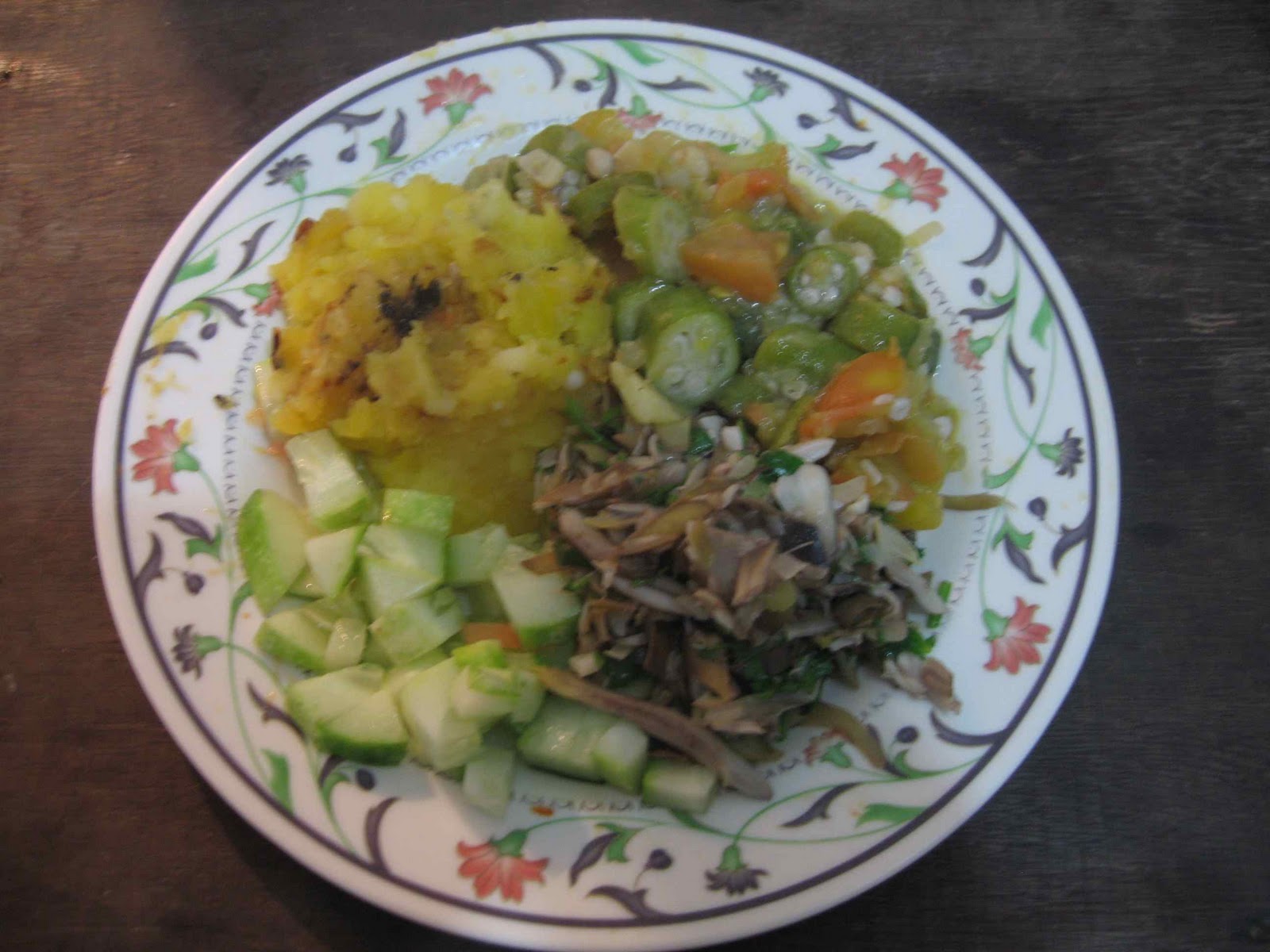
Opting out of the meat enthusiasm from the farmers' market, I served (to myself) the cilantro-sauteed banana slivers with sliced cucumber, okra stewed with tomatoes, and one of my favorite South American roots, batata baroa, aka mandioquinha, or the less graceful sounding "Peruvian parsnip," a tuber with a delicately sweet yet distinctively potato-y taste and a cheery, translucent egg-yolk color.
 

And what did the banana flower taste like?

Not at all like a flower or any other vegetable I've had, but more like a mushroom, in its meatiness and a certain umami quality (that elusive fifth flavor), though with a lighter texture and flavor than a mushroom. It was difficult to detect a banana aroma, though I imagine this is stronger when eating more tender, uncooked flowers that are often used in Southeast Asian and South Asian banana blossom salads. Yes, I liked it, and yes, it was worth the effort, though perhaps not a daily endeavor.

A while back I wrote a post on edible flowers in which I quoted Adorno and Horkheimer on the way that eating flowers is something of a gesture toward the aesthetics of food detached from the practical injunctions of "rationally planned eating." The banana flower is of a different edible order, it seems. Seeming more aesthetic to prepare and for the idea of a flower than how it looks on the plate, the banana flower is decidedly undelicate and unflowerlike, of a hearty rather than delicate nature. And, like banana the fruit, it contains plenty of potassium and other nutrients sought out by rational eaters that you can read about here.

Neverthless, some irrationality abounds in this episode. When I told the guys at the evangelical luncheonette across the street that I had gotten banana flowers at the market, they laughed at my silly gringa ways and said, "Around here, no one buys banana flowers. They grow everywhere!" Point taken.

Read more about banana flowers at what I've come to think of as my Brazilian sister site, Flavors of Brazil.

Wednesday, October 5, 2011

The Indomitable Ninja Broccoli (Brócolis Ninja)


SÃO PAULO.
Victory, at last. For months now, ever since a hot tip came in on the wire from Paulistano WV agent Ervilho Frita ("Pea Fry," though I've happily butchered the Portuguese rules of masculino/feminina and reinvented "ervilha" as a macho pea-o), I've been stalking the (in)famous Ninja Broccoli, part of the stealth gang of green mercenaries known in these parts as Brócolis Ninja.

It may look like a normal head of broccoli, but this is no ordinary inflorescent, no. Its floret might look rotund and jolly like its average American counterpart but the ninja broccoli's cat-like swiftness and diabolical cunning are dead serious.

The ninja broccoli is a variant that cropped up mysteriously amidst fields of the previously more common (in Brazil) sprouting broccoli, or brócolis ramoso, which has more numerous branchings and thinner stalks. Another complication is that this chubby ninja known as "normal" broccoli in the U.S. is called "calabrese" in Britain (from Calabria in Italy), a name whose fancy foreign connotation U.S. farmers apply to the other, thinner, more exotic, usually heirloom, and sometimes royally purple-tinged sprouting type. An insane amount of broccoli lore can be had here.

As might be expected, the origins of the "ninja" identity of this broccoli in Brazil are somewhat obscure. In Rio, no one at the farmers' markets had even heard of "brócolis ninja." "Must be from São Paulo," many of the vendors mused about the Japanese-sounding name. São Paulo state has the largest population of Japanese descent in Brazil, a country that has has the largest population of Japanese descent outside of Japan. Most Japanese immigrants originally came as farmers, beginning at the end of the nineteenth century. If you are surprised by this, read more here.

Sprouting broccoli is considered tastier but the "one-headed broccoli," or ninja broccoli (brócoli de cabeça única) is easier to harvest with one swoop of the blade, more weather resistant, and holds up well in the freezer section, so its popularity in the veggie marketplace has risen.

To return to our origin tale... this site (in Portuguese) claims that ninja broccoli began to sprout as a genetic accident, a hybrid among fields of "normal," or sprouting broccoli (recall that the U.S. "normal" broccoli is this genetic aberration). At first, farmers considered it an undesirable variant but could not get rid of this broccoli that kept appearing and spreading mysteriously. A Japanese scientist, who preferred to remain anonymous, compared these cunning broccoli to ninjas, and the name stuck, immediately snatched up by marketing professionals as a stroke of genius: Ninja broccoli, your kid's favorite vegetable. Sounds suspicious? Well, the site is called "Crazy Train" (Trem Doido), so factor that into whether you believe it or not. Maybe we are to believe this story to the extent that we believe that this guy is a deadly Broccoli Ninja:

left on my virtual doorstep by
Brazilian vegetable queen V. Berinjela

So far, I haven't been able to find any other explanation of why it's called "ninja broccoli," and for now we might come to the simple conclusion that it just sounds cool, ninjas being arguably one of the coolest figures to come out of Japanese history and lore (unless you're partial to samurais. It's kind of like that old Goddard or Truffaut debate). Anyone with more information, please comment. I will update if I find anything at the library (the Internet has exhausted me for the time being).

image source

Friday, September 30, 2011

Sophisticated Corn

São Paulo is one sophisticated town. People don't live their lives in flip-flops, the best coffee isn't just for export, the graffiti is better than gallery art, and the homeless people have more style than anyone with money, assembling outfits with that impossible-to-imitate creative intuition for pitch-perfect clashing normally achieved only by the most talented Japanese hipsters and Marc Jacobs.

One of my favorite mid-afternoon snacks in Rio de Janeiro was something from the corn man: a pamonha, curau (a kind of corn pudding made with sugar and condensed milk), or boiled corn-on-the-cob served in its pale green husk. On one of my first days here in São Paulo, while wandering alone down Avenida Paulista, one of the city's main arteries of finance, commerce, and culture, I spotted a happily familiar sight: corn man!

Only something was different. I couldn't put my finger on it at first, but something about his piles of candied coconut chunks and sweet roasted peanuts seemed a little too tidy. I ordered: "One corn, please." Using a long, two-tined barbecue fork, corn man fished out a bright yellow corn cob from the vat of boiling salted water, but instead of placing it into its snug corn husk jacket, he set it over a small plastic bowl and started carving it with an elegant efficiency I had never witnessed in Rio. I stared and pulled out my camera. He looked annoyed at my bumpkin tourist antics, like the best of the New York hot dog vendors (note the NY baseball cap):


I remarked that while living in Rio I had never seen anything like what he was doing, shaving off the corn kernels into such a civilized spoonable snack, and he seemed somewhat pleased by the contrast (São Paulo and Rio being rivals in the same sort of way that San Francisco and Los Angeles thrive on their differences from each other, though the particular stereotypes between each pair differ). I paid my R$3 and continued on down the avenue, spooning steaming fresh corn kernels into my mouth like a contented baby, free from anxieties of hot water spilling down the husk onto my forearms or corn getting stuck between my teeth for the rest of the afternoon. While there's something satisfying about tearing off a row of kernels with the toothy force of your own hunger, the corn carving is a clever idea for a pre-meeting (or pre-museum, in my case) snack.

see how neat his stacks are?